







Welcome to the official website of Nesfo Valve Manufacturing (Quanzhou) Co!

Soft seal gate valve uses and advantages of analysis

Soft seal gate valve uses and advantages of analysis

2026-03-23

This article explains the core advantages and application value of soft seal gate valve. Its excellent elastic sealing performance effectively prevent leakage, reduce energy consumption and safety risks; simple structure, easy operation, long maintenance cycle, significantly reduce maintenance costs and downtime; at the same time with excellent corrosion resistance, wear resistance and long life, to adapt to harsh working conditions, can significantly reduce the cost of business operations. Soft seal gate valve is the key equipment to improve the efficiency and safety of industrial piping system.
Hard seal butterfly valve application areas

Hard seal butterfly valve application areas

2026-03-23

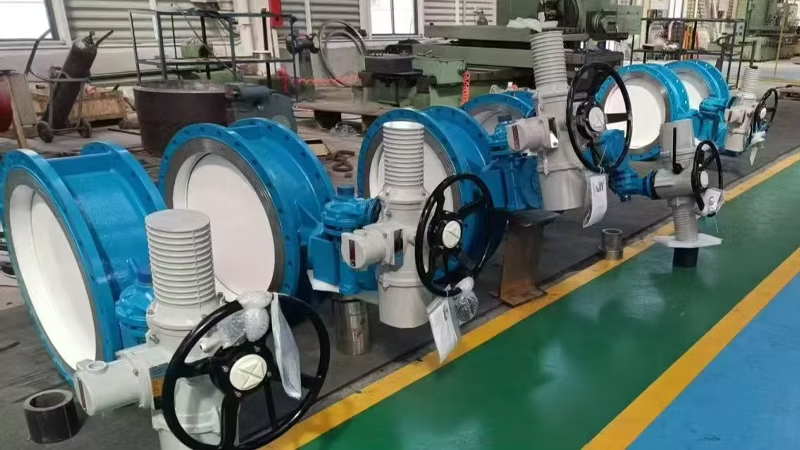
Hard seal butterfly valve with its simple structure, convenient operation and excellent sealing performance, has become a key fluid control equipment for high temperature and high pressure, corrosive media and other harsh environments. This article focuses on its wide range of applications in the chemical industry (precise control, corrosion resistance), oil and gas (high pressure and high temperature transportation and processing), as well as electric power, metallurgy, papermaking (regulating water, steam, gas, pulp and other media) and other industrial fields, to meet the requirements of high stability and reliability, and to effectively improve production efficiency and safety.

The role of Y-filter in pipeline

The role of Y-filter in pipeline

2026-03-23

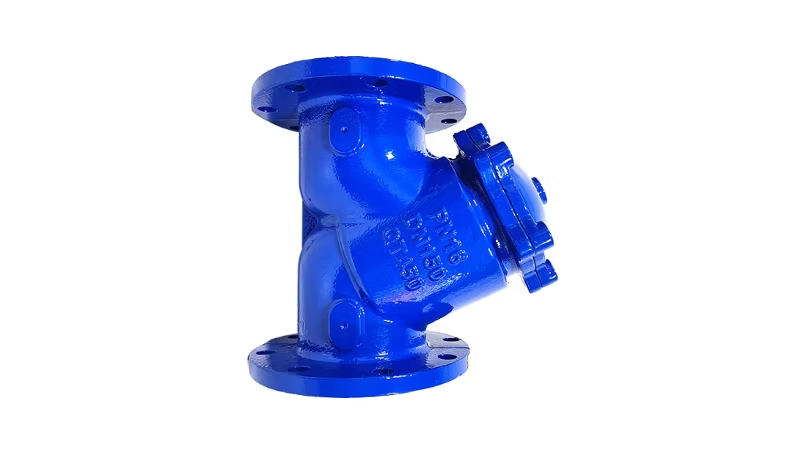
With the unique Y-shape design, the Y-filter can efficiently filter impurities and solid particles in the fluid, protect piping equipment from damage, significantly improve the system's operating efficiency and stability, and have the advantage of easy cleaning and maintenance, which is an indispensable key equipment in industrial and commercial piping systems.

Specific functions of check valves

Specific functions of check valves

2026-03-23

Check valve is the key equipment to prevent fluid backflow in pipeline system, which is crucial to ensure the safe and stable operation of the system. Its core role includes: effectively preventing the reverse flow of fluids, significantly reducing pipeline pressure loss, protecting equipment from damage caused by pressure fluctuations, and helping to save energy and reduce emissions. Reasonable application of check valves can enhance system efficiency, safety and economic and environmental benefits.

Types of valves commonly used in water supply systems

Types of valves commonly used in water supply systems

2026-03-23

This article analyzes the water supply system five core valve types and applications: ball valves (reliable sealing, fast opening and closing, suitable for small and medium-sized pipeline cut-off); butterfly valves (lightweight and easy to operate, the main control of large flow regulation); gate valves (durable full diameter, used for the main pipeline opening and closing); check valves (to prevent the medium from backing up, to protect the safety of water pumps); regulating valves (accurate control of the flow control pressure, adapt to the precision of the water supply scenarios). Scientific selection can improve system efficiency and water supply safety.

What common types of drain valves include

What common types of drain valves include

2026-03-23

This article takes a look at the common types of sewage valves and their application scenarios: gate valves (low flow resistance, suitable for large flows of solids-containing wastewater); butterfly valves (compact, lightweight and quick to operate, suitable for wastewater treatment); ball valves (excellent sealing, low flow resistance, suitable for viscous/crystallized media); check valves (to prevent backflow and safeguard pipeline safety); and regulating valves (to control the flow rate/pressure accurately for complex wastewater). Selection should be based on the combination of fluid characteristics (temperature/pressure/chemical composition/solid particles), piping size, and operation and maintenance, in order to enhance the efficiency of wastewater discharge and environmental safety.

Butterfly valve can withstand how high temperature limit

Butterfly valve can withstand how high temperature limit

2026-03-23

This article analyzes the limit of high temperature resistance of butterfly valve and key influencing factors. Temperature resistance depends on material, technology and seal structure:
EPDM Seal: -20℃~120℃
Nitrile Rubber Seal: 0℃~80℃
Teflon sealing: 0℃~150℃
Stainless steel seal: -29℃~425℃ (optimal temperature resistance)
The actual selection needs to synthesize the fluid type, pressure, temperature fluctuations and other working conditions to ensure stable operation in high temperature environments.

Material selection of seawater valves

Material selection of seawater valves

2026-03-23

This paper discusses the selection of valve materials for seawater environments, emphasizing the critical impact of seawater's strong corrosive properties (containing chlorine ions, salts and microorganisms) on the safety of equipment and smooth processes. Core materials include: stainless steel (such as 316L, high corrosion resistance, strong mechanical strength, suitable for seawater treatment and marine engineering); copper alloy (corrosion resistance and antibacterial, suitable for seawater desalination and ships); plastic (lightweight and low-cost, but weak, suitable for low-pressure, small-diameter valves). When choosing, it is necessary to consider the seawater composition, process requirements and operating environment to ensure stable operation of the equipment.

Types of Valves Commonly Used in Heating Plumbing

Types of Valves Commonly Used in Heating Plumbing

2026-03-23

In heating supply systems, the correct choice of valves is essential to ensure efficiency, temperature control and system stability. This article provides a brief overview of six commonly used valve types: temperature control valves (to automatically regulate room temperature), motorized valves (for remote control), globe valves (for flow regulation), solenoid valves (for quick response), three-way valves (for flow balancing) and pneumatic valves (for special environments). Each valve's features and applications are outlined to help engineers optimize their choices based on system size, functional requirements and user expectations to improve energy efficiency and comfort.

Commonly used types of manual valves

Commonly used types of manual valves

2026-03-23

Manual valves are key control elements in the pipeline fluid transportation system, widely used in industrial fields, designed to ensure smooth fluid transportation and safe operation of the system. This article focuses on four common types: manual butterfly valve (simple structure, convenient operation, divided into handle type and worm gear type, applicable to different caliber pipeline), manual gate valve (commonly used in water distribution system, divided into open rod and concealed rod type, opening and closing status intuitive), manual ball valve (used to cut off the flow, shunt and adjust the direction of flow, opening and closing parts for the ball) and manual disconnecting valve (good abrasion resistance, maintenance is convenient, but opening and closing torque, nominal diameter). (≤200mm). Selection needs to be based on the pipeline characteristics and working environment to ensure that the system is efficient and stable.

Are gate valves suitable for steam piping

Are gate valves suitable for steam piping

2026-03-23

Gate valves are theoretically suitable for steam piping and can effectively block the flow of steam. However, high temperature and high pressure environments require extremely high sealing performance, and the risk of leakage due to thermal expansion and contraction can lead to energy waste or safety accidents. Safe and stable operation of gate valves can be ensured through proper selection (e.g., use of cast steel), precise installation, and regular maintenance (inspection and replacement of seals). To summarize, gate valves can be used in steam pipelines, but they require comprehensive consideration of operating conditions, performance and maintenance to achieve a reliable function.

What is a safety valve?

2026-03-23

What is the load factor of a steam trap?

2026-03-23

The operating temperature of a steam trap refers to the temperature under what conditions and at what location?

2026-03-23

What is the significance of back pressure in steam traps? Is it better to have a high or low back pressure allowance? Why?

2026-03-23

What is subcooling? What is the difference between open-valve and closed-valve subcooling? Which one has more subcooling?

2026-03-23

What is gauge pressure? What is absolute pressure? What is the relationship between gauge pressure and absolute pressure?

2026-03-23

What is sensible heat? What is latent heat?

2026-03-23

When selecting a steam trap, why is it important to multiply the discharge capacity of the steam trap by a safety factor?

2026-03-23

What factors should be considered when selecting a steam trap?

2026-03-23
WeChat
WeChat
WeChat
WhatsApp
Message

Contact Us for Your Exclusive Service!